Claude Fable 5.2: 20% cheaper, a 2.5x fast mode, and fewer requests handed to older models
Anthropic's Fable 5.2 and Mythos 5.2 cost $8 and $40 per million tokens, beat Opus 5.5 on most published tests, and block about 55% fewer requests. What changes for developers, with the benchmark table and prices.
On November 9, Anthropic released Claude Fable 5.2 and Claude Mythos 5.2, ten weeks after the 5.1 pair. The headline numbers are a 20% price cut, outputs up to 30% faster, and a new fast mode. The more useful change for anyone building on the API is narrower: the safeguards that quietly hand some requests to older models now fire about 55% less often, and API customers must now configure how that handoff works.
Anthropic’s launch page, dated 9 November 2026. Screenshot: anthropic.com
One model, two names, two doors
Anthropic is direct about the naming: “Claude Fable and Claude Mythos are the same underlying model.” Fable is that model with cybersecurity and biology classifiers on top, which is what lets Anthropic sell it to everyone. Fable 5.2 is on Pro, Max, Ultra, Team and Enterprise plans and on the API as claude-fable-5-2, through the Claude Platform, AWS, Google Cloud and Microsoft’s cloud, according to Anthropic’s Fable page.
Mythos 5.2 is the unfiltered version and stays behind an application. Organizations get it through Anthropic’s Life Sciences and Cyber Verification Programs, and Enterprise customers can use it inside Claude Security without joining the cyber program, as Fortune and MacRumors also report. If you are not in one of those programs, Fable 5.2 is the model you can call.
Pricing: per token, per task, and a fast mode at double the rate
Both models cost $8 per million input tokens and $40 per million output tokens, down from $10 and $50 for the 5.1 generation. Cache reads are $0.20 per million, and pinning inference to US-only infrastructure adds a 1.1x multiplier. The new fast mode costs $16 and $80 and generates tokens up to 2.5 times faster. It runs in Claude Code, on the Claude Platform, on Google Cloud and on Microsoft Foundry; for Mythos it is limited to verified organizations.
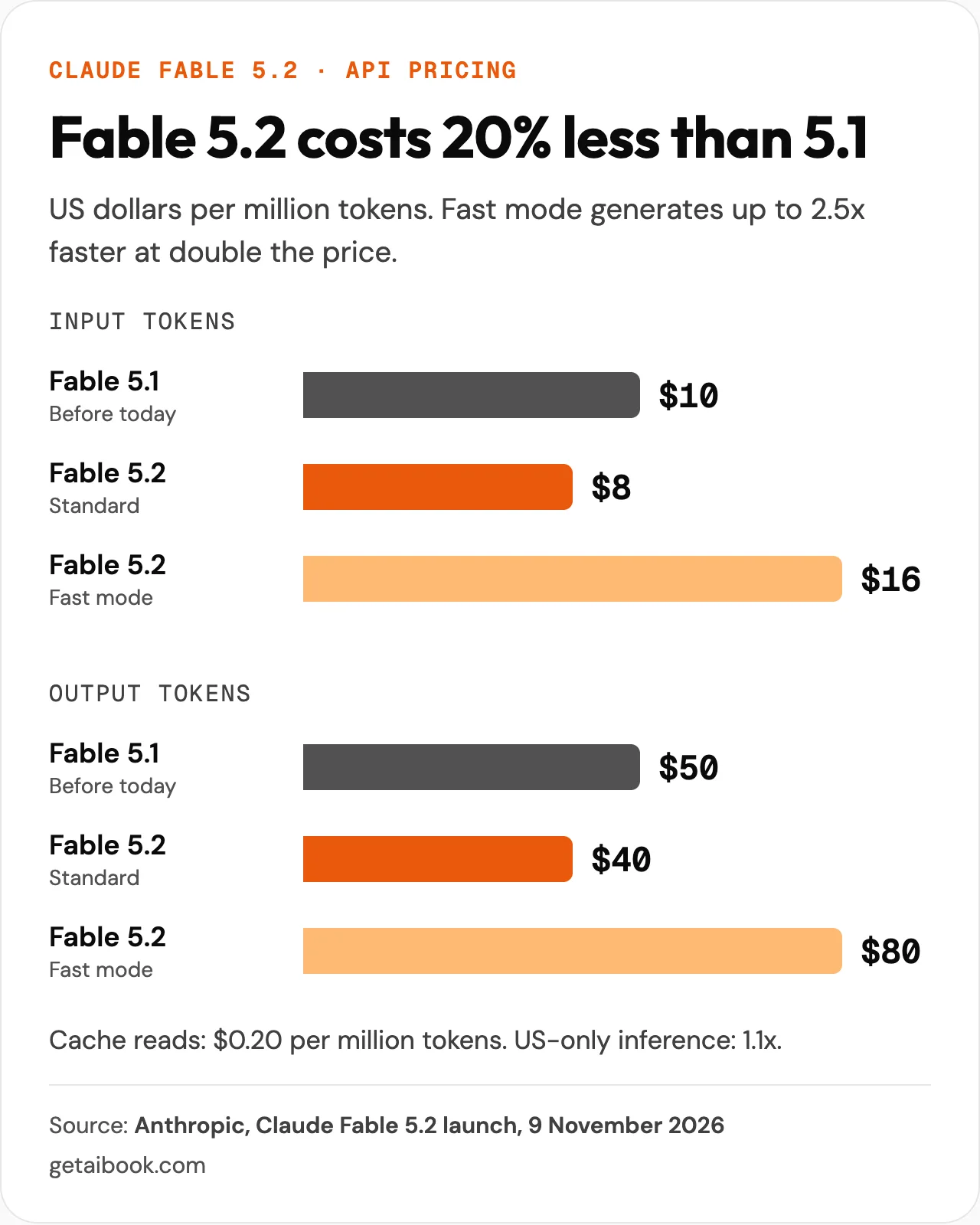
Chart: GetAIBook, from Anthropic’s published prices.
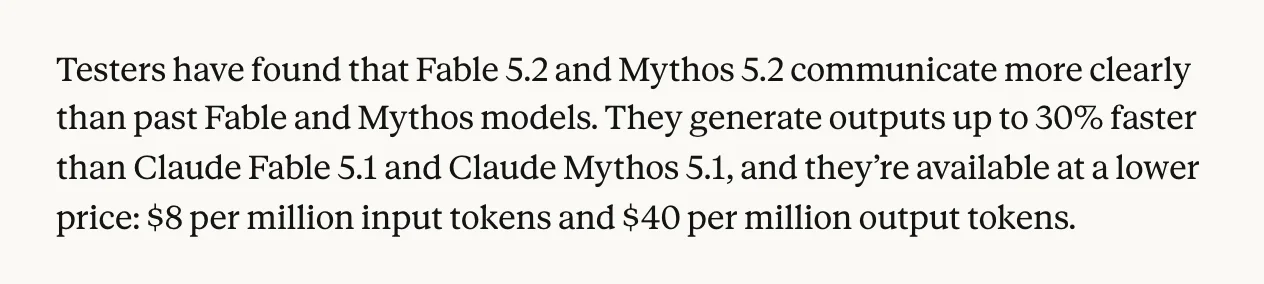
The price in Anthropic’s own words. Screenshot: anthropic.com
The per-token cut matters less than Anthropic’s per-task claims, because reasoning models are billed for how much they think. On its FrontierCode 2.0 coding test, Fable 5.2 at High effort scores 45.3%, close to Opus 5.5’s best of 45.5%, “for roughly half the cost per task.” On the WANDR search benchmark it matches Opus 5.5’s top score at Medium effort for about 40% of the cost, and on Humanity’s Last Exam it does so at Low effort for under a tenth. Medium is the default in Claude apps and Claude Code, and Anthropic says Fable 5.2 finishes hard tasks there with fewer tokens than 5.1 did. Those are vendor numbers on vendor-chosen tasks, so the honest test is your own workload at each effort level.
Fortune puts the standard price 20% below OpenAI’s GPT-6 Astra and cached reads 80% below it. Those comparisons rest on Fortune’s figures for Astra; Anthropic’s pages do not list OpenAI’s prices.
Benchmarks: where it leads, and where it does not
Anthropic’s table compares Fable 5.2 with Fable 5.1, Opus 5.5, GPT-6 Astra and Gemini 4 Carbon, each at its highest available effort and with safeguards on. Fable 5.2 leads most rows. The large gaps are in long, open-ended work: 41.3% on the Remote Labor Index against roughly 21% for Opus 5.5 and Astra, and 64.9% on the RoboDojo robotics simulation against 39.4% for Opus 5.5, though Anthropic ran that last one internally.
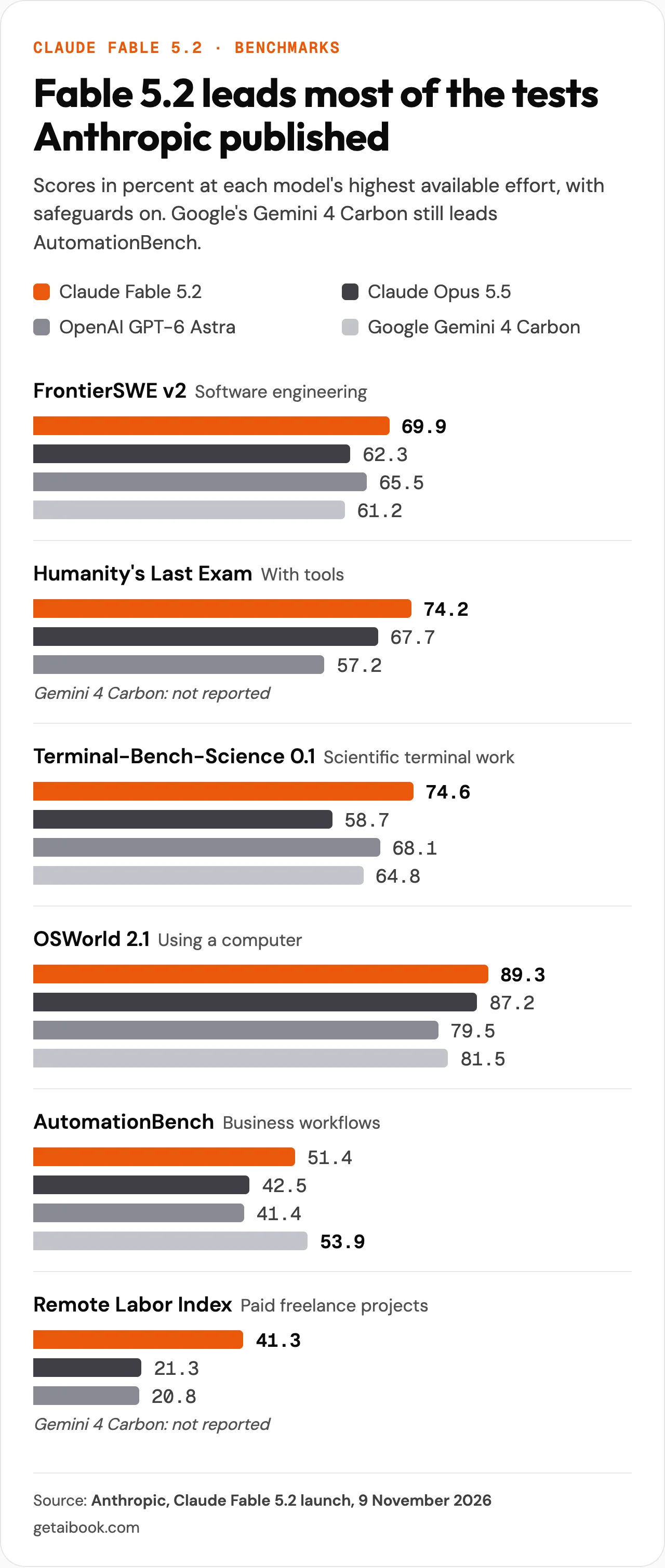
Chart: GetAIBook, from the scores Anthropic published.
Two rows go the other way. Google’s Gemini 4 Carbon leads AutomationBench, a business-workflow test, at 53.9% to Fable’s 51.4%, and Opus 5.5 keeps a narrow lead on the AA-Briefcase Elo rating, 1800 to 1785. On computer use (OSWorld 2.1) the margin over Opus 5.5 is only 2.1 points. Note also that the cybersecurity and protein-design rows report Mythos 5.2, not the Fable model most developers will call.
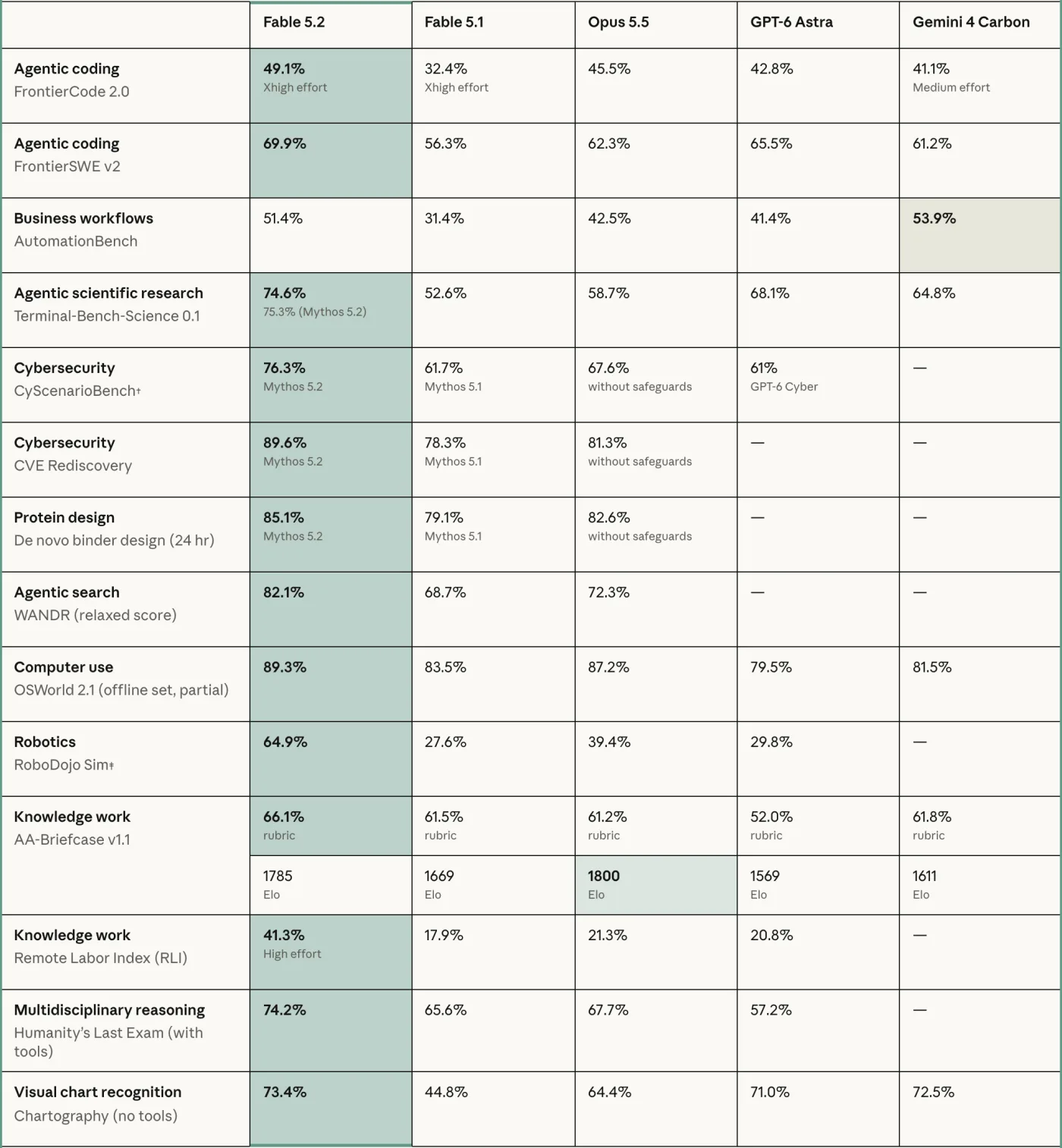
Anthropic’s full benchmark table. Screenshot: anthropic.com
The Fallback API and the 55% fewer blocks
Fable’s classifiers still block penetration testing, exploit generation, binary vulnerability work and most research biology. When they fire, the answer comes from a different model: Opus 4.8 for cybersecurity and Opus 5 for biology. Anthropic also routes a small set of AI research topics, such as accelerator kernel optimization, to Opus 5. In the apps this happens transparently. On the API, Anthropic says customers “must configure their settings with our new Fallback API” (Fable page).
That makes fallback a design decision for anyone shipping Fable in a product. If your traffic touches security tooling or life-science data, some responses will come from an older model with different strengths, and your evaluation, logging and user messaging should account for which model actually answered. The good news is the rate: Anthropic reports about 55% fewer blocks than Fable 5.1, roughly 60% fewer in cybersecurity and 40% fewer in biology, with safeguards it describes as equally robust.
The benchmark table is honest about this too: scores for Fable 5.2, Fable 5.1 and Opus 5.5 are reported with safeguards on, so the numbers above are what a filtered model delivers. For the previous release’s pricing changes, see our coverage of Fable 5.1’s cache price cut.
How Anthropic wants you to route work
Anthropic is not pitching Fable 5.2 as the default. Its advice is to start with Opus 5.5, “our strongest daily driver,” then move up to Fable for the hardest problems or down to Sonnet 5.5 and Haiku 5.5 for cheaper ones. It also suggests using Fable 5.2 as an “Advisor” or “Orchestrator” over smaller models, which fits the per-task numbers: a model that plans well at Low or Medium effort can direct cheaper workers without paying for High effort on every step. CNBC quotes Dianne Penn, Anthropic’s head of product management for research, describing Fable 5.2 as being for “power users or power use cases” (CNBC).
One constraint belongs in that routing decision. Using Fable models requires 30-day data retention for safety monitoring by default. Zero data retention is available only to eligible enterprise customers through Enterprise Frontier Safeguards, which is in private beta. Teams under strict retention rules may find Opus 5.5 is the model they can actually deploy.
What to watch
Independent results come first. Every number above is Anthropic’s, and the system card and third-party leaderboards will show whether the per-task savings hold outside its own harness. Second, the timing: CNBC reports Anthropic’s IPO could come as soon as next week, and this is its first frontier release since Dario Amodei called for a slower pace in September. Third, Anthropic says this release carries its strongest protections against distillation, cutting data harvestable through outputs by 90% to 99%. For developers who use frontier outputs to train smaller models, that is a policy change worth reading closely before building on it.

Get Insanely Good at AI
The book for developers who want to understand how AI actually works. LLMs, prompt engineering, RAG, AI agents, and production systems.
Keep Reading
How to Automate Workflows with Claude Code Routines
Learn how to use Claude Code's new routines to schedule tasks, trigger API workflows, and automate GitHub PR reviews on cloud infrastructure.
Hidden Caching Costs Make Sonnet 4.6 Cheaper Than GPT-4.1
IBM Research reveals that production model routing algorithms fail when ignoring cache-read prices, showing Claude Sonnet 4.6 beating GPT-4.1 on task costs.
PSI says a non-public Anthropic model proved the Aaronson-Ambainis conjecture, with a full Lean check
Physical Superintelligence says its research system, running an unreleased Anthropic model, proved a central open problem in quantum query complexity by day three of a run. The 9,454-line Lean formalization uses no added axioms; independent review has only just started.
Gemini 4 Carbon nine days on: top of the index, a third of Claude's task cost, and still no API
Google's October 28 frontier model leads Artificial Analysis at 59 and costs about $16 per GDPx task against Opus 5.5's $51. Developers still cannot call it, its hallucination rate rose on one test, and its linked safety report reportedly covers Argon.
METR: Anthropic is improving at about 2x its old pace, mostly because of AI
Days after Anthropic's S-1/A warned it may imminently meet its own definition of AI-driven acceleration, METR estimated a 1.9x speedup in benchmark growth and attributed about 80% of it to AI, while saying most of its best evidence was redacted.