Learn Igbo: The Free App I Built for My Own Language
Igbo has tens of millions of speakers and almost nowhere to learn it properly. Asụsụ Ọma is free, with guided lessons, games, folktales and every phrase recorded by a native speaker.
Most of what I publish here is about AI. This one is about something else, built over countless nights.
Igbo is my language. It has tens of millions of speakers and it’s losing them. So many of us understand it and can’t answer back: children who follow every word an elder says and reply in English, whose own children then grow up not hearing Igbo at all.
I built Asụsụ Ọma so we can answer back, and so our children grow up speaking it.
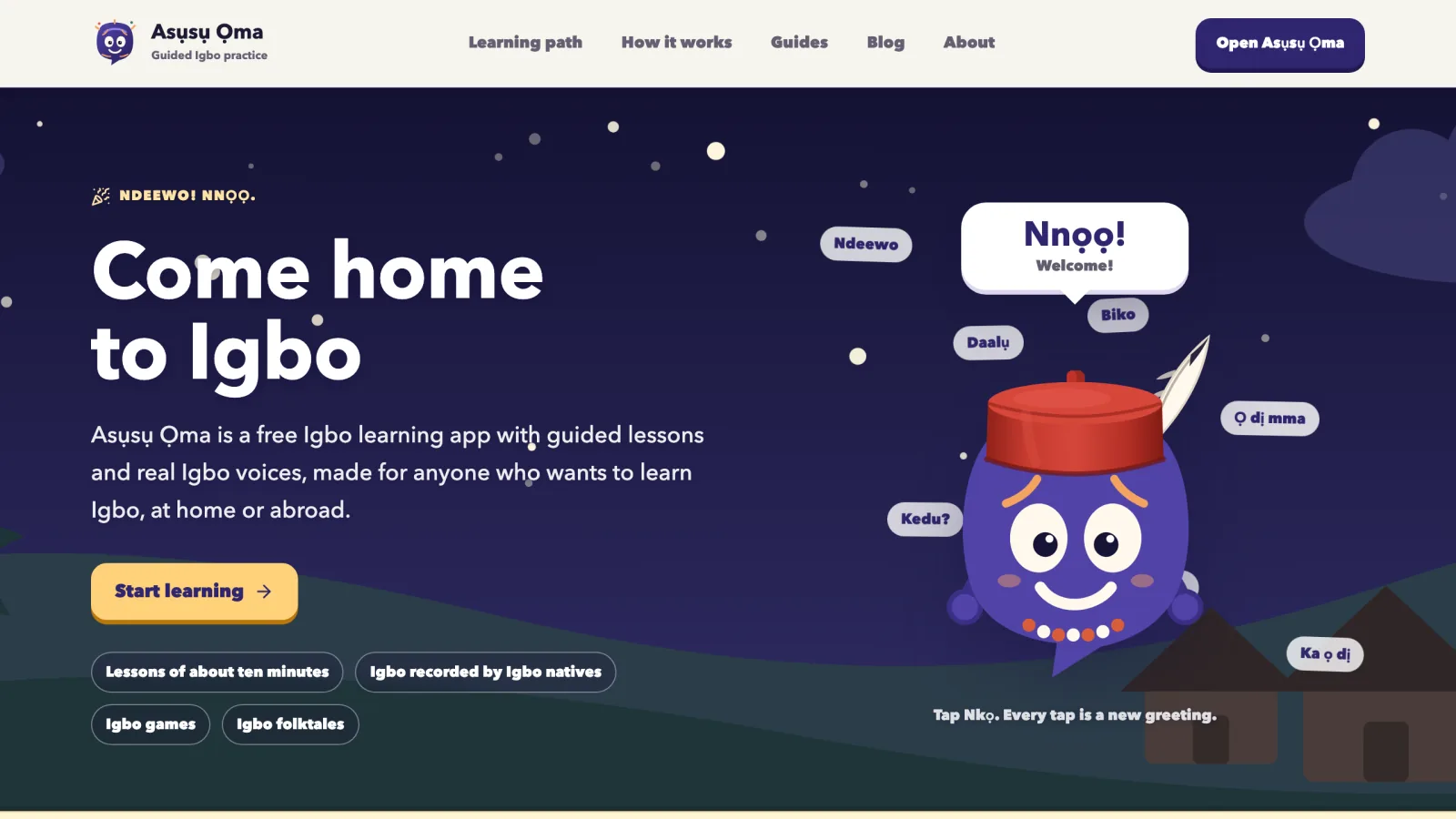
What’s in it
If you go looking for a way to learn Igbo today, you find scattered word lists, a few videos, and PDFs that give you spellings with no indication of how anything sounds. The large language apps don’t teach it at all.
Asụsụ Ọma teaches it in short lessons, about ten minutes each, running in order along a path so you never have to work out what to study next. Every phrase is a recording of a native speaker rather than a synthetic voice, mine among them. That matters more in Igbo than in most languages, because tone is part of the word: the same spelling with different tone marks can mean something else entirely.
Behind the lessons there are over a thousand recordings of native speakers, each tied to a word page with its tone-marked spelling and the sentences it’s really used in. Around them there are games built from the words you’ve already learned, and Igbo folktales read aloud by native speakers, where any word can be tapped for its meaning and pronunciation.
There’s an Android app on Google Play, in beta while testing runs, and on iPhone it installs to the home screen straight from the browser. Either way it keeps working offline once the lessons are cached, which matters on an uneven connection.
Everything in it is free, and it stays that way
No ads, no subscription, no premium tier, no lesson locked behind a payment. Every lesson, game, folktale and recording is yours from the first day.
Igbo is losing speakers with every generation. The last thing it needs is a price on the door. A language survives when the next generation can reach it, and a paywall would shut out exactly the people who need it most.
Who it’s for
Complete beginners, and people like me who grew up around Igbo and were never taught to speak it properly. Either way it starts at the first greeting.
If that’s you, or someone in your family, it’s at asusuoma.com.

Get Insanely Good at AI
The book for developers who want to understand how AI actually works. LLMs, prompt engineering, RAG, AI agents, and production systems.
Keep Reading
AI Wiped Out Kenya's Essay-Writing Industry, Erasing 40,000 Jobs in Two Years
The New York Times reports that Kenya's shadow-scholar industry, an estimated 40,000 Nairobi writers producing college essays for overseas students, has shrunk to nearly nothing within two years of ChatGPT's release.
Jeff Dean Leaves Google for $650M Science AI Startup Axiom
Jeff Dean has resigned from Google DeepMind alongside key researchers to launch Axiom Research, a startup backed by $650 million to build scientific AI models.
DeepMind Embeds AI Researchers at A24 in $75M Studio Deal
Google has invested $75 million in independent film studio A24 to build artist-driven pre-production tools without granting access to existing training data.
OpenAI Hires Noam Shazeer for Post-GPT-5 Architecture
OpenAI has hired Transformer co-inventor Noam Shazeer and former White House adviser Dean Ball as it prepares for a highly anticipated IPO.
Anthropic Hires AlphaFold Lead John Jumper From DeepMind
John Jumper, the Nobel laureate who led the development of AlphaFold, is leaving Google DeepMind after nine years to join AI rival Anthropic.